|
4
min read
|
Varun Aggarwal
Hiring has become increasingly difficult to manage manually. Talent pools are larger, roles are more specialized, and speed now plays a critical role in securing the right candidates. Most teams use multiple hiring tools, yet the process still relies heavily on humans coordinating systems, reviewing profiles, and pushing decisions forward at every step. It is like being a traffic controller for tools that should be smarter by now.
The pressure is especially visible in enterprise hiring automation contexts, where recruiting teams are expected to fill dozens of specialized roles simultaneously without proportional increases in headcount. The old model of stacking more tools on top of each other has hit a ceiling. Adding a new sourcing tool, a separate screening layer, and a standalone outreach platform does not make the process smarter. It just adds more coordination overhead for already stretched recruiters.
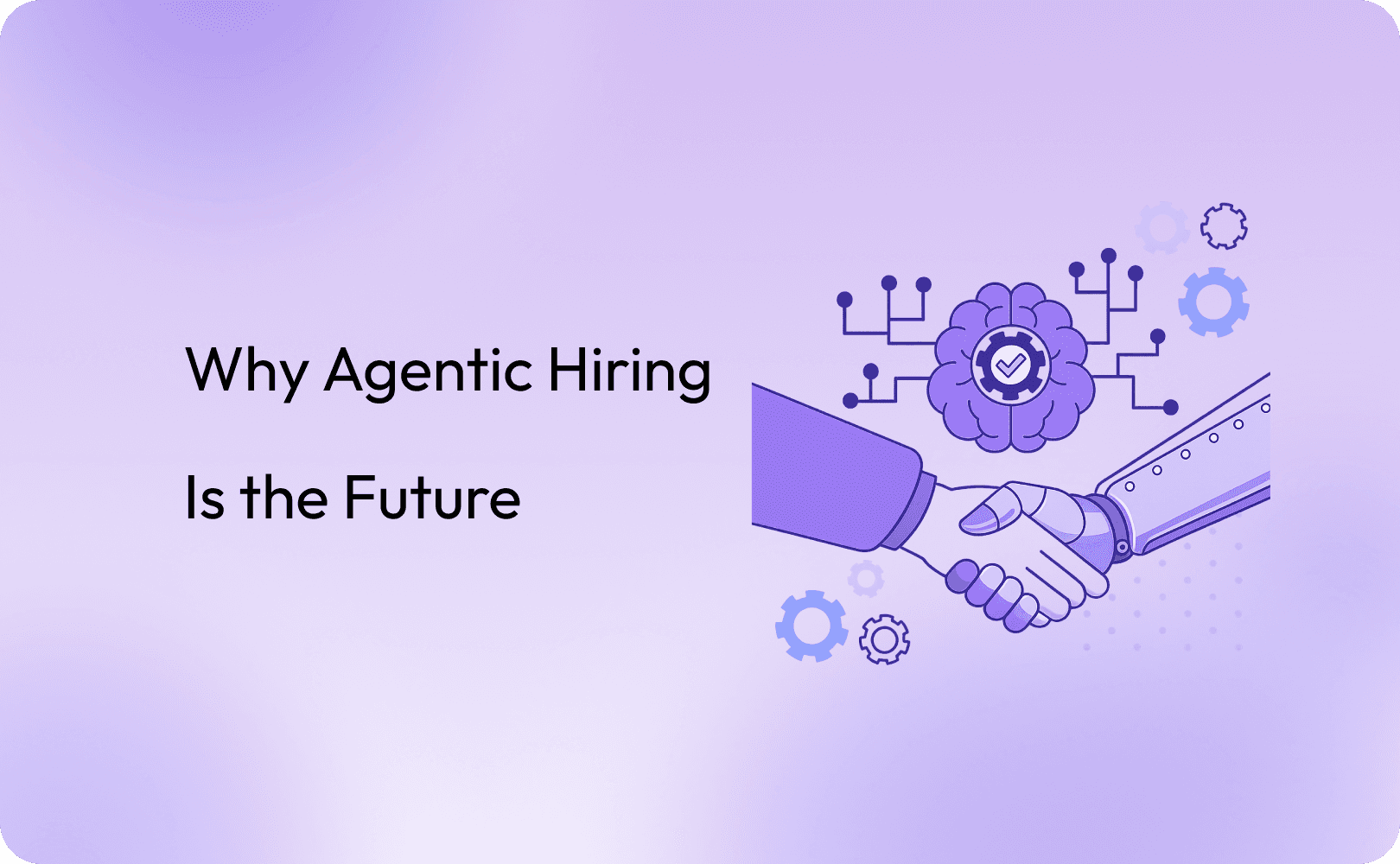
Agentic hiring emerges as a response to this complexity. Instead of adding more tools or workflows (because surely tool number 47 will fix everything), it introduces intelligent agents that can operate across the hiring process and improve continuously through feedback.
What makes hiring truly agentic
Agentic hiring is not just about automation. We have had automation for years, and it mostly gave us keyword filters that reject people for writing "managed teams" instead of "team management." Truly agentic systems can act with intent, learn from outcomes, and support human judgment at scale.
Four core capabilities define agentic AI hiring in 2026:
Autonomous execution across the funnel: Agents source candidates, evaluate fit, and initiate engagement without constant human input, while operating within clearly defined boundaries. They do not go rogue. They work within guardrails you set. This is fundamentally different from traditional recruitment automation tools, which require manual configuration at every step and break down the moment a role requirement changes.
Continuous learning from recruiter decisions: Every shortlist, rejection, and hire becomes feedback. Over time, agents adapt to how your team actually evaluates candidates. It learns what "good culture fit" means to your team, not some generic definition pulled from a job description template. This is what makes AI candidate matching genuinely useful rather than just faster keyword matching under a new name.
End-to-end ownership, not isolated tasks: Agentic systems operate across sourcing, screening, and engagement, reducing manual handoffs and context loss. No more "wait, why did we reject this person again?" The agent holds the context across the entire funnel, so nothing falls through the cracks between tools or team members.
Human-in-the-loop control: Recruiters remain in charge. They review suggestions, override decisions, and guide the system. This is not about replacing recruiters. It is about giving them superpowers. The recruiter's judgment does not disappear from the process; it gets amplified and scaled across a pipeline that would otherwise be impossible to manage manually.
These capabilities turn hiring from a sequence of manual steps into a system that improves with use. The more you hire, the smarter it gets.
Why this shift is needed now
Hiring volume continues to increase, while recruiter capacity does not scale at the same pace. Traditional tools help teams move faster, but they do not scale judgment. As competition for talent intensifies, relevance and timing matter more than effort alone. Working harder does not help if you are three days late reaching the best candidate.
Static systems struggle here. They require constant tuning and fail to adapt as roles, markets, and candidate behavior change. Every market shift means someone has to manually reconfigure the rules. Agentic systems improve as conditions evolve, making them necessary rather than optional.
The cost of manual sourcing is also worth examining directly. When a recruiter spends 30 to 40 hours a week on sourcing and outreach, that time is not available for the conversations and decisions that actually close strong hires. Multiply that across a team handling 20 or 30 open roles, and the math becomes uncomfortable quickly. Scaling hiring without proportionally growing the recruiting team is only possible when the repetitive, high-volume work at the top of the funnel is handled autonomously. That is the exact problem agentic hiring solves.
For teams in fast-growing markets like India, where demand for AI/ML, cloud, and product engineering talent consistently outstrips supply, the inability to move quickly on passive candidates is a significant competitive disadvantage. The best engineers are rarely applying. They need to be found, contacted with relevant context, and moved into conversations before a competitor does the same.
How agentic hiring changes day-to-day work
The impact shows up quickly. Recruiters spend less time screening profiles and more time interviewing and engaging candidates. You know, the human work that actually matters. Pipelines stay active without constant manual effort, and time to fill becomes predictable instead of a monthly surprise.
Consistency improves too. Agentic systems apply learned decision logic across large candidate pools, reducing fatigue-driven variation. Your hiring quality becomes less dependent on whether someone had their coffee that morning. Over time, quality improves because decisions are informed by accumulated learning rather than one-off judgment under pressure.
For recruiting leaders managing enterprise hiring workflows, this shift also changes how capacity is planned. Instead of asking "how many recruiters do we need to fill 50 roles this quarter," the question becomes "what does each recruiter need to focus on for each of these roles to close well?" The top of the funnel runs autonomously. The human bandwidth is reserved for interviews, offer negotiations, and the relationship work that determines whether a great candidate actually joins.
Adopting agentic hiring in practice
The transition does not require giving up control or making dramatic overnight changes. Teams can start with agents in suggestion mode and measure improvements in shortlist quality, response rates, and recruiter time saved. As confidence builds, agents can take low-risk actions like initial outreach or scheduling.
A useful phased approach looks something like this. In the first week or two, the recruiting team defines roles clearly and reviews the agent's early shortlists carefully, giving explicit feedback on each decision. By the third or fourth week, patterns emerge and the shortlists tighten noticeably. By the end of the first month, most of the top-of-funnel work is running without manual intervention, and recruiters are spending the majority of their time on candidate conversations rather than profile browsing.
Platforms like Kodiva are built for this phased approach. By learning directly from recruiter decisions, Kodiva's agents improve with every role and every shortlist, while keeping humans firmly in control. The system gets smarter. Your team gets more leverage. And your hiring quality finally scales instead of degrading under volume.
The bigger picture: future enterprise hiring technology
Agentic hiring is not a passing trend or the latest buzzword that will fade next quarter. It is the next logical step in scaling hiring without sacrificing judgment, quality, or human oversight. The organizations that will have a structural advantage in talent acquisition over the next three to five years are the ones building their hiring processes around systems that learn, not systems that just execute.
The future of enterprise hiring technology is not a better ATS or a faster sourcing database. It is a system that understands how your team hires, gets better at doing that over time, and frees your recruiters to do the work that cannot be automated: building genuine relationships with candidates, assessing motivation and fit, and making the calls that shape the team.
The question is not whether this shift is coming. It is whether you will adopt it early or play catch-up later.